This is a brief post on the large fire (>50,000 acres) along the Niobrara River in Nebraska. See Chris Helzer’s excellent Prairie Ecologist blog for amazing photos on the ground in the aftermath of the fires at TNC’s Niobrara Valley Preserve. The steep slopes and canyons along the Niobrara Valley represent the easternmost extent of the range of Ponderosa Pine, and a unique system where pines meet the transition between mixed and even tallgrass prairies, and while the fire did not burn through nearly all of the Niobrara Ponderosas, a large area is going to be fundamentally different for a long time. Below is a MODIS image from the area taken today (true color). The more southeasterly (bottom right) brown scar represents the footprint of the fire, and you can still see some smoke. The dark green that runs east-west along the river represents the forests. Dark green spots are agricultural fields with center-pivots with the exception of some wet areas between sand hills in the bottom center.
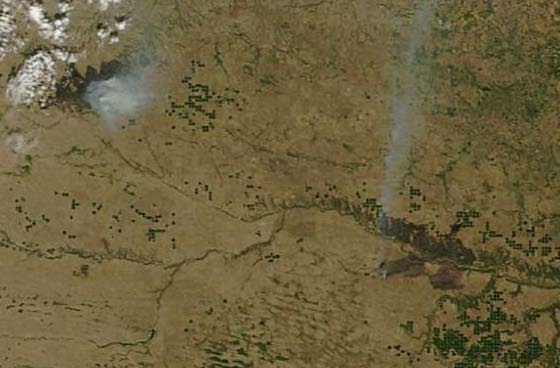
One can clearly see the trace of the Niobrara River in Nebraska and the darkened footprint of a fire along the Niobrara and another large fire to the northwest in this MODIS image from July 24. Smoke still rises from both.
This is a comment motivated by comments on the Prairie Ecologist blog (www.prairieecologist.com). Some see fires like this as good, natural, and promoting diversity, and I think that analysis oversimplifies the issue:
I’m inclined to think that a fire eliminating a solid stand of trees that has reduced understory diversity might lead to a diversity increase, but I am also inclined to think that a savanna state rather than a complete kill at reasonably large scales of the types of trees that are natural to the area (although widely interspersed) reduces opportunities over the coming decades to maximize diversity, because savannas contain more environmental gradients than open grasslands. The resident species pool there is likely much different, but where large swaths of Ponderosa have been eliminated in New Mexico (and not only in the last two years, but even on fire scars from late from 10-30 years ago) many areas are thickets of Robinia and Gambel oak with few or no regenerating pines and little herbaceous layer. Admittedly I am not as familiar with that area (N. Nebraska), but I am familiar with Ponderosa forests in the west, where large scale crowning is leading to fundamental and persistent changes, and the rate at which new areas are being lost is faster than historic fire regimes can be restored and trees and the understory plant communities and associated fauna can recover.
I am not saying this because I like to look at forest, I am a prairie guy, and I work in a region where woody encroachment has demonstrably reduced diversity. That said, open Ponderosa woodlands and savannas (or areas that historically were) are something increasingly precious, and in a period of profound and rapid global change, populations near the edges of ranges are particularly vulnerable and also valuable, because of their potential to harbor unique genetic resources for broader conservation.
I view overly dense stands of Ponderosa the same way I would view an overly dense stand of trees in with a few big oaks on a former savanna in Eastern Iowa…I would love to see them thinned, but I would mourn large scale losses of all or most of the trees, because they are part of the definition of the landscape and essential to the livelihood of a subset of other species they occur with.
I also don’t view historical conditions as universally sustainable targets (emphasis on universally). The climate is measurably different now from the pre-settlement climate, and it is impossible to escape elevated N and CO2 fertilization and the effects of introduced species. In 80-90 years the best estimates tell us that the mean temperatures where I live, Northeast Kansas, will be approximately what they have been this year (warmer to date than any year in 120 year record). It is obvious that this will profoundly change things (this year asters and big bluestem bloomed in May). And this is precisely why diversity is of maximum importance, and not just diversity of species, but diversity of land cover types, and perhaps one could argue that this fire increased the diversity of land cover types, and that would warrant pondering. I think as people we are too attached to history, and that attachment is defeating to the preservation of the diversity, the species, that we love.




You must be logged in to post a comment.