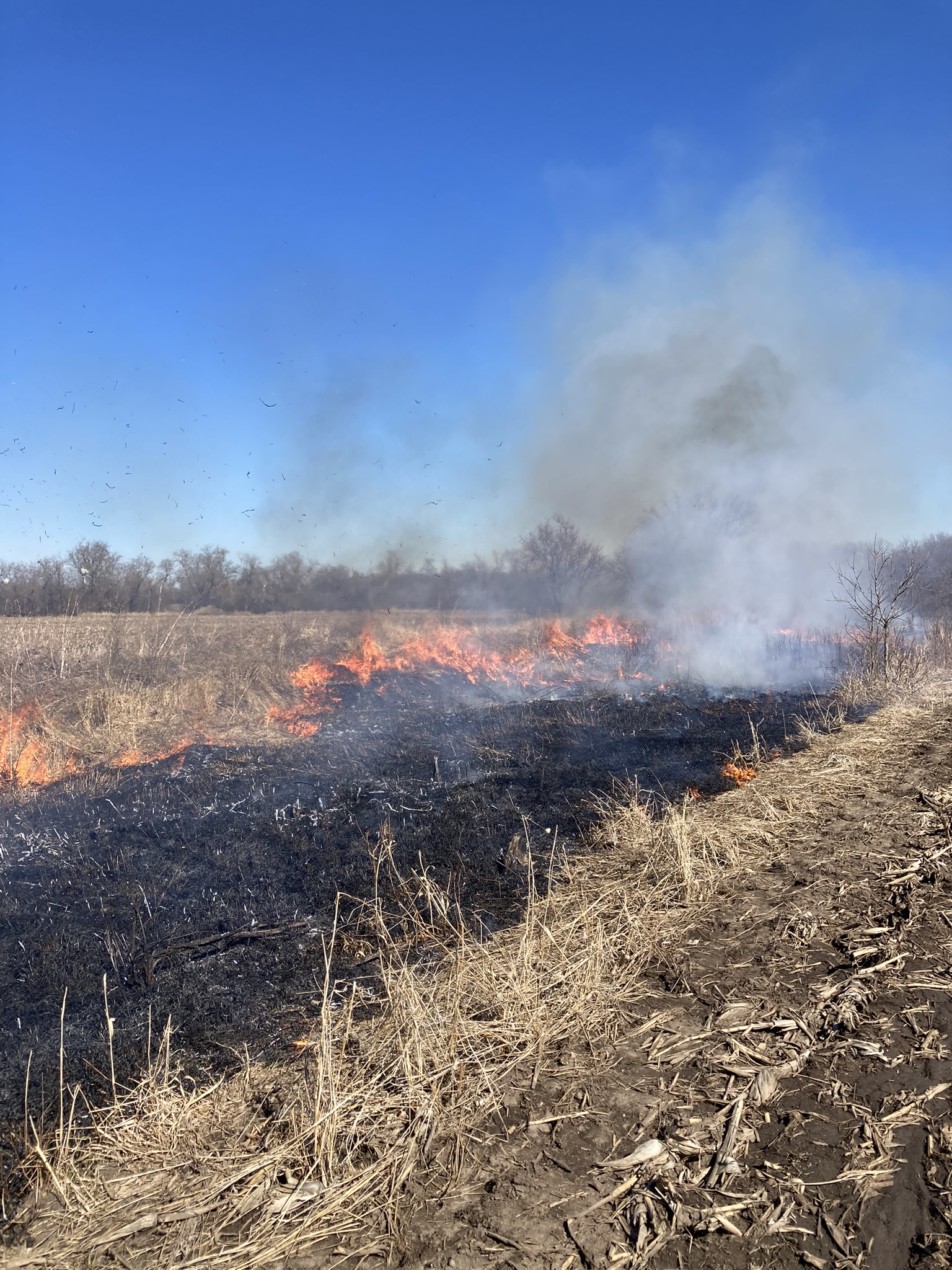
Cold rain is beginning to fall, but it still smells like smoke outside this morning, April 29. Smoke columns have risen all across southern Wisconsin over the preceding days, making up for alternating red flag and wet conditions that stymied burning earlier.
Frequent fire is essential. The sods of woods and prairies need relief from their accumulated thatch and leaf litter in order to exist abundantly, just as many animals must shed their skin cells or exoskeletons to allow for renewal and growth. Frequent fire is also essential to reduce fuels so certain members of the sod (floral and faunal) don’t cook when it burns. However, as the volatile organics from the smoke tickle my nostrils, I can’t help but consider its sources and the consequences for going ahead with burning at a time when almost all of the most important components of old growth sods in prairies, savannas, and woodlands have emerged. Some have flowered. Prairie dropseed stands at about five inches. Leiberg’s panic-grass stands at three. Little bluestem is emerging, even on north slopes. Bastard toadflax is fully emerged and buds white. Healthy woodlands are brimming with fertile sedges. Amethyst shooting star is flowering in the Driftless. The lime foliage of bur and maroon foliage of white oak is slowly unfurling from buds, catkins dangling. On the mild days between rain and graupel, bumble bee queens are busy about. The American lady has been at her oviposition on cat’s foot for almost a month.
Spring burning is the most common practice in southern Wisconsin. Some years its early. Sometimes its late. A few years ago I would have said it’s better to burn any time than not at all. More and more people seem to feel that way. I have been thoroughly disabused of that sentiment. Below are a few of the reasons…words of others that can say it better than me, and some from me.
I was relieved that the Glacial Prairie Chapter of TPE was once again able to get fire onto Benedict Prairie (a remnant RR prairie) in the dormant season. Burns the last three seasons have been March-late fall-March.
Forgotten Fires: Native Americans and the Transient Wilderness (2002): Omer Stewart (Historical Fire Accounts from much of North America): Jam-packed with historical accounts of widespread, requent fall fire.
The Once and Future Great Lakes Country: An Ecological History (2014): John L. Riley (broader ecological history of the Great Lakes/Northeast): A more complete snapshot of the Great Lake Region near the time of European contact–not the 1800s.
Timberhill Final Report: Gerould Wilhelm and Laura Rericha offer wonderful synthesis of how oak woodlands work, and where autumnal fire fits in. It may seem an odd source, but read it.
Plant Ecology (1938): Weaver and Clements in the context of Clements’, Hensel’s, and Later Towne’s and Owensby’s work at the Agricultural Experiment Station, Manhattan Kansas (late spring burning, the typical land use in the area, caused uplandstate transition (mid/bunch-grass to tall, rhizomatous grass) from bunchgrass to long-rhizomatous C4 dominance and forb reduction between the early and late 20th century. This is as much to do with belowground bud banks and both bud and elongating meristem positions as it is to do with photosynthetic pathway.
Along the lines of Bowles and Jones (above), proof is in the response of long-managed places. To borrow a term from Wilhelm, the most fecund expressions of reconstructed prairie (Mound’s View grassland, where plantings have become old-growth like), remnant prairie (e.g. Black Earth-Rettenmund), oak savanna (e.g., Sugar River Savanna or Pleasant Valley Conservancy) are burned more often than every other year in the dormant season (fall or very early spring). It works. Does that management eliminate entrenched brush, no, but it minimizes the threat it poses to ecological integrity, and it inoculates against new encroachment. The frequency is as important as the seasonality. Very frequent fire sustains a generally thatch-free condition where fire doesn’t linger to burn down through old material while the flaming front moves forward. This prevents mortality of bunchgrasses (whose regenerative buds are at the surface), allows biological crusts to form and persist, and almost certainly mitigates impacts to invertebrates (often coarse stems persist, protective bunchgrass stubble persists, there is essentially no heat penetration into the soil, see Dana 1991 regarding thatch, fire, and skippers). Wilhelm has pointed out that there is no study of annual autumnal fire on the invertebrates in woods and prairie (of course old-growth-associated and rare species of of greatest concern), which appears to be true, and is astounding given historical accounts. Instead, most studies track effects of occasional fires in higher fuel environments. In my experience, every instance of ecological healing that approaches ecological potential has utilized very frequent dormant season fire (in some of the driest circumstances, perhaps every 3-4 years). Note that mere improvement over ecological collapses is a lower bar, and that’s not what I’m talking about.
Accounts of fire in our prairies, savannas, and woodlands in the Midwest and Northeast are nearly unanimous in their description historical fire as very frequent or annual, autumnal, widespread, and set by people. This is historical versus scientific knowledge, but we ignore it at our peril. If our understanding of the Civil or Revolutionary wars were solely dependent on scientific analysis of artifacts we can dig up now versus the historical record, how well would we understand those events? Our means of inferring historical fire from fire scars on trees, for instance, can tell us when and where fire definitely occurred, but their absence does not prove the absence of fire. Annual fires through sedges and leaf litter in areas that burned the year before, and the year before that have trouble harming mature, thin-barked understory trees like ironwood and alternate-leaved dogwood, or consuming the stems of purple Joe-Pye, let alone putting a scar on oak or anything else with bark more than a few millimeters thick. They do remove or reset woody seedlings, top kill small-diameter brush, and prevent build-up of smothering litter. Of coarse, the latter is anecdote. Anecdote is all that is possible when the contemporary use of annual, dormant season fire intended to remove litter for prairie/savanna/woodland herbaceous sod integrity vs. woody vegetation control is so rare. There is essentially no research on the response of the vegetation conservative to old-growth sods. Instead, responses of functional groups, richness, and diversity are the best we get, but these are meaningless without the context of conservatism. Communities can be native-dominated and be species rich, while also being profoundly degraded. Also, the context of species responses is important. Where woodland sods have been lost and burning is simply removing leaf litter to expose bare ground or sparse, weedy vegetation, the response of weedy species to a given fire treatment means something completely different than it does where sods are relatively intact or at least restorable. I’ve seen no evidence that analysis of forestry plots stratifies data in this way. So there is science and data, but the right questions have not been asked, and the right data has not been collected to support employing novel fire regimes.
The old-growth sods of woods and prairies are emergent properties of the interaction of species as boreal, eastern, southern, and western floras and faunas have expanded and contracted under the influence of people since much of the Midwest was under ice, probably also expansion of open and closed conditions that has occurred for various reasons at site to regional scales as well. Sure, there were once in a blue moon disturbances that caused local harm, but the landscape was intact and could heal. There were grazers and browsers, but they were transient, their behavior modified by predators and human hunters. They weren’t fenced and focused as domestic livestock and now sometimes those same herbivores are today. There was fire, and it’s frequent application by indigenous people was perhaps one of the strongest stabilizing and balancing factors on the landscape. That fire may have come out of season now and again, but not as a matter of practice. When atypical disturbance becomes regular, it falls outside of the ecological memory of old-growth sods, and it can precipitate state change (Exhibit A: Flint hills grasslands, #4 above).
Most old-growth vegetation is relatively nitrogen efficient, and much nitrogen and other nutrients are withdrawn from foliage in dormancy. However, if its living tissues are cooked and left behind looking like cooked asparagus after a late spring or summer burn, where are those nutrients going? What kinds of species are going to pick it up. I don’t know! Maybe nitrophilous weeds. But common sense urges caution. I’m much more comfortable dumping the meagre nutrient loads of dormant, conservative vegetation, with some of the nitrogen going up in smoke or having some time to leach or even be re-acquired (along with other nutrients) by the old-growth sod than I am of spreading it around during the full-on growing season. We do know that high nitrogen availability is disruptive.
The beauty and fecundity of the year is worth mentioning. Put simply, don’t burn the damn fully emerged shooting stars, bellwort, bastard toadflax, prairie smoke, woodland phlox, and on and on. These things are expressions of community health, expressions better cultivated than extinguished. Their colors are beautiful, their integration of deep time’s comings and goings is as meaningful as anything else created in cooperation with, or simply by human hands. My opinion. Art is OK too.
Black Rettenmund Prairie is burned frequently in the dormant season, both ends two out of every three years, and the middle every other year. It’s a keyhole view into a lost world.
The hope with fire in any season is that we can undo ecological harms from invasive species or past disturbance with large scale management. Increasingly, I think that’s a fool’s errand. There isn’t going to be a whiz-bang quick fix. It takes close, connected work from people. Healthful fire is fire that promotes stability–not fire that shocks and kills at scale. It is dormant season fire. Good old fashion invasive species and brush work is another part of it, so is interseeding of species lost to the system. We can defibrillate woods and prairies bereft of their old-growth species all we want, they won’t come back once their hearts have been hollowed out. Today there’s no hope of extending that kind of care to the landscape. That’s terrible, but it is what it is. We can still save and carry forward really important places and the species they support until society itself changes its relationship with the land in such a way that we are all involved with stewardship at least indirectly. If we don’t do that, we’re screwed anyway.
Sugar River Savanna was degraded by pasturage, but almost 50 years of annual fire in early spring (except maybe ~3 years) and augmenting the remaining native species with inter-seeding of species likely lost has led to this. Much of this site has 20+ native species per quarter square meter. When fire is stable, reliable, and in tune with the historical cultural and biological hum of our biota and the communities of which they are part, restoration can do this.
When do I think most burning should happen? Fall. Winter. As early as spring as possible, in southern WI before between 4/1 and 4/15 depending on the year. Late summer (late August/September) might be OK in some specialized circumstances. I don’t have much to say based on experience and reading. …I hope it’s OK! I don’t assume it is.
I do know that we’re all just doing our best not to let every last grain of sand on this dying planet slip through our fingers.
Caveat: I’m talking about promoting old-growth and old-growth-like prairie/savanna/woodland sods that are complex and resistant to change (if we burn them a lot in fall). Fire may be applied differently to prepare for restoration (e.g., late burning of brome CRP to prep prairie interseeding) or simply to manage habitat structurally for more narrowly focused habitat goals, though I think that is less sustainable long-term than natural community-based restoration.
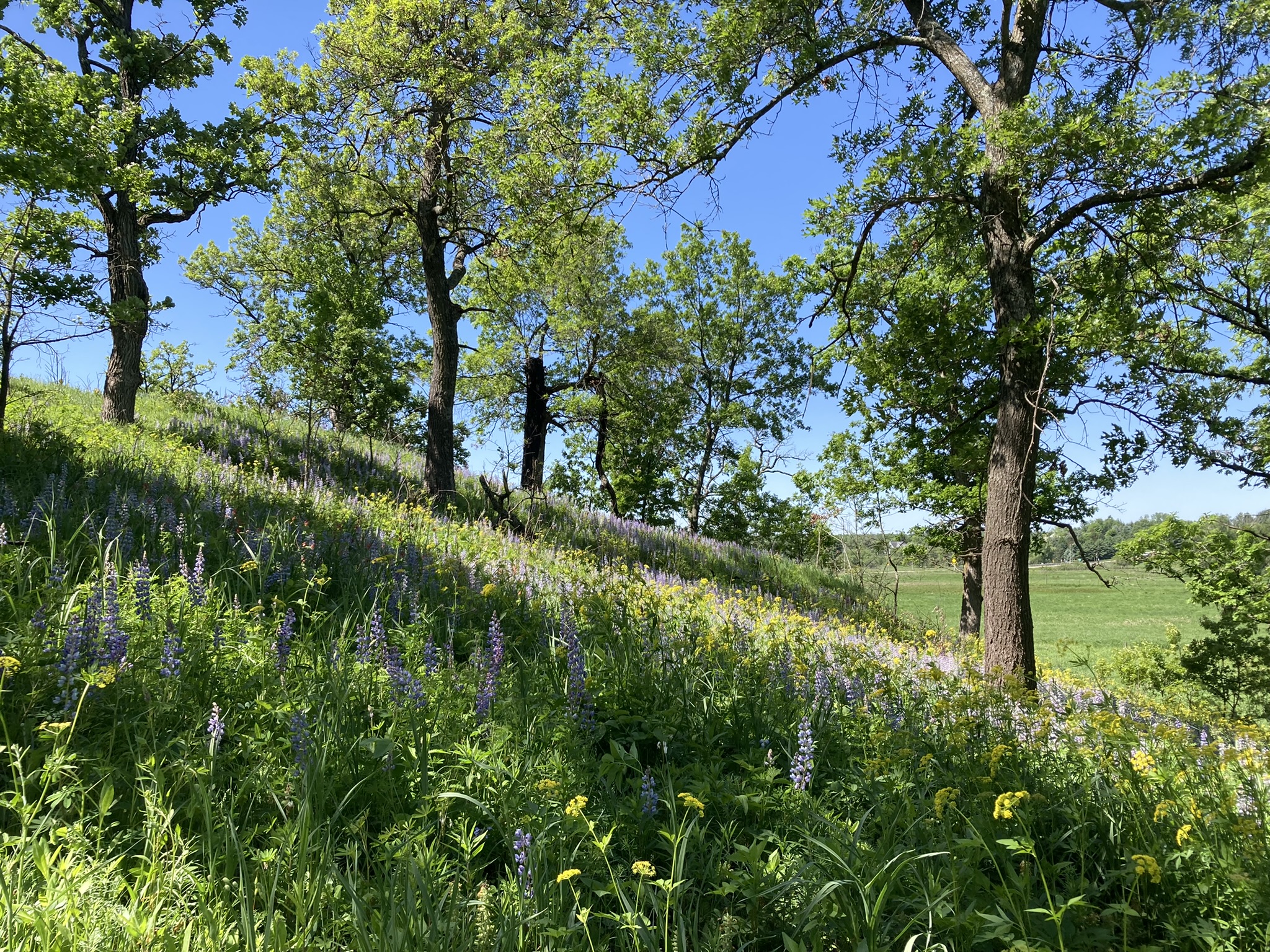
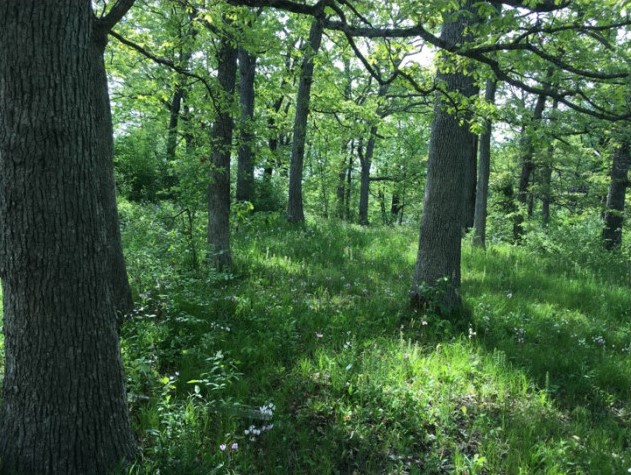
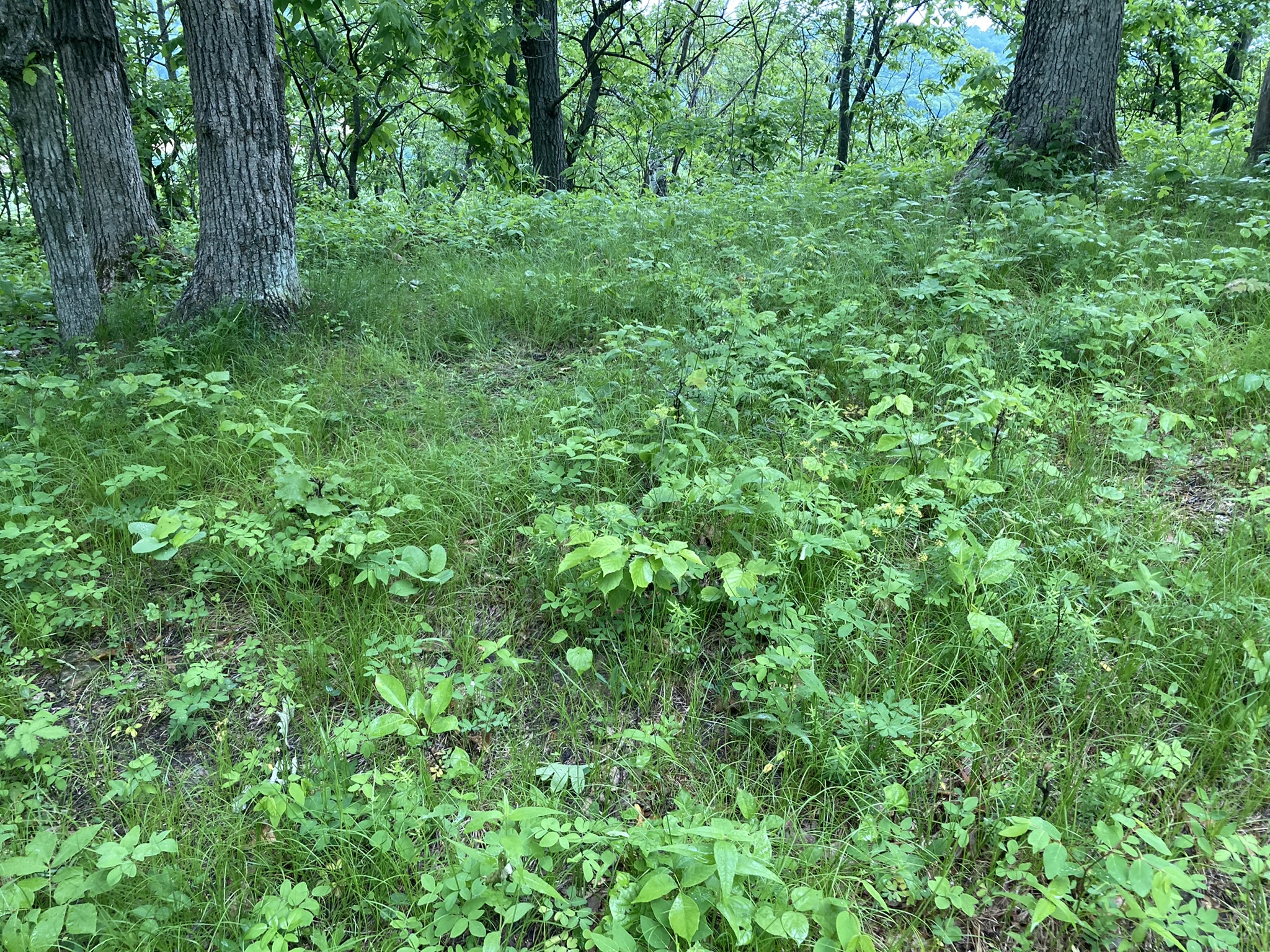
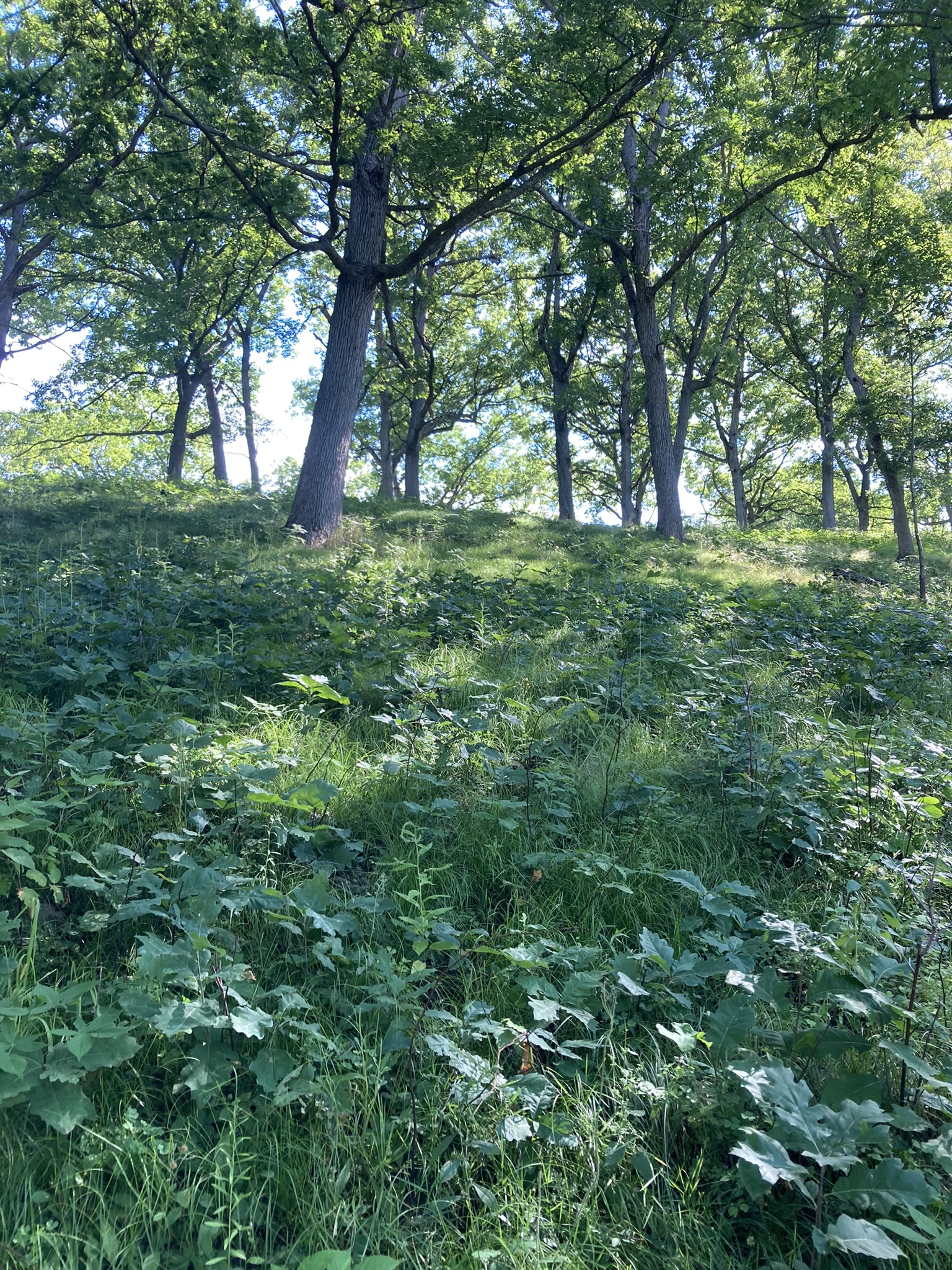
Oak woodlands and prairies are related. In a broad sense, oak woodlands are also grasslands (or graminoid-lands), often supporting rich sods of herbaceous plants set in a matrix that includes grasses and sedges (and often common wood rush). In Wisconsin both oak woodlands and oak openings are lumped together under broader savanna, but oak woodlands are deserve special attention. They are communities of dappled light filtered through oak—neither dark forest nor fully exposed. They are as defined by their herbaceous vegetation as they are by their trees, but very seldom do oaks still coincide with intact, old-growth woodland sod. Are truly intact woodland sods as rare or rarer than prairie sods? Perhaps. Three very common and widespread historical factors have driven the decline of oak woodland—grazing, fire exclusion, and forestry practices. The best remnants are found where one or more of these factors was muted various factors–access, wind blowing leaf litter clear. All too often, opportunities to restore woodlands go unrecognized in favor more open savanna types or management of closed forests. In this post my aim is to show some small fragments of oak woodland, mostly degraded but still recognizable as such. One thing to notice is that the vegetation is low and grassy, regardless of time of year. I’ll be adding to this post over time.
This remnant oak woodland at the Army Lake Boat Launch in Walworth County (the foreground is paved now) is / was truly remarkable. Located on a knoll surrounded by open water and peatland, it was likely minimally disturbed before an access was created in the 1950s. It’s possible that the topography and openness to the lake exported leaf litter that would have otherwise smothered its sod. Mesic and situated on silt loam soils, it supports huckleberry and velvet-leaf blueberry.
An image of the old growth sod of the Army Lake Woodland–a matrix of common wood rush, savanna running sedge, Pennsylvania sedge, Robin’s plantain, wood betony, yellow stargrass, and common blue-eyed grass. Other areas are co-dominated by species including bastard toadflax, forked aster, Carolina vetch, pale vetchling, New Jersey Tea, and midland shooting star.
Another bit of Army Lake Woodland sod, here full of two-flowered Cynthia, Carolina vetch, and bastard toadflax.
This is Summit Bog Island in Waukesha County, a knoll of silt loam soils surrounded by peatlands. It is moderately compositionally and structurally degraded, but unlike most areas, the understory has not yet become choked with invasive shrubs. It remains graminoid-dominated. The main issue is the slow encroachment of ironwood, black cherry, and shagbark hickory. Here too, at least some potentially smothering leaf litter is exported by wind.
A view of the sod at Summit Bog Island. Visible are velvet-leaf blueberry, Pennsylvania sedge, savanna running sedge, red vine honeysuckle, Parlin’s field cat’s-foot, shining bedstraw, and grove sandwort. Carolina vetch, pale vetchling, Maryland black snakeroot, bastard toadflax, showy goldenrod, arrow-leaved aster, and poverty oatgrass, northern hawkweed, common wood rush, rough hawkweed, and broad-leaved panic-grass, are among the other species present, but much appears suppressed here due to conspicuous severe deer browse. The “island” knoll is a hub connecting all the deer paths through the surrounding peatlands.
This oak woodland on a northwest-oriented ridgetop dolostone point in the Trempealeau County. Here Pennsylvania sedge, savanna running sedge, poverty oatgrass, and broad-leaved panic-grass are among the graminoids. Yellow pimpernel, Carolina vetch, and northern bedstraw are abundant. Woodland sunflowers are atypically benign. A more red oak-domianted north slope supports low bush honeysuckle, broad-leaved panic-grass, poke milkweed, yellow lady’s slipper, and northern bedstraw.
This Iowa County oak woodland over sandstone suffers somewhat from excessive leaf litter accumulation, but Pennsylvania sedge and Swan’s sedge are both present. Forbs include midland shooting star, northern hawkweed, rough hawkweed, hoary frostweed, stiff aster, showy goldenrod, and bastard toadflax. White oak grubs/seedlings are abundant, as they often are under a high oak canopy where the understory hasn’t become too full of brush and small trees.
Oak woodland in historically heavily grazed area at the toe of an esker in Walworth County. Nonetheless, the graminoid structure is retained and there is much white oak regeneration. Midland shooting star, alumroot, Pennsylvania sedge, Swan’s sedge, and common wood rush are present.
Woodland on south slope under white and red oak (canopy was present in 1940 as well) at another “island” woodland remnant near Army Lake in Walworth County. This island is a kame or kame-like structure and consists of rocky-domomitic till. Prominent graminoids are savanna running sedge, Leiberg’s panic-grass, Pennsylvania sedge, poverty oat grass, slender wheatgrass, and common wood rush. Large yellow false-foxglove, lead plant, bastard toadflax, showy goldenrod, sky-blue aster, shining bedstraw, northern bedstraw, kittentails, midland shooting star, Robin’s plantain, and early goldenrod are also present.
Historically heavily grazed oak woodland over sandstone in Richland County. Pennsylvania sedge, poverty oat grass, savanna running sedge, hoary frostweed, prairie pinweed, rough hawkweed, and northern hawkweed are among the remaining flora. White oak seedlings/grubs are dense.
An open portion of an “island” (thicketed areas were historically more open) between Lulu and Eagle Spring Lake in Walworth County. Carolina vetch, grove sandwort, alumroot, and broad-leaved panic-grass are among the species present.








 Prairie Botanist
You must be logged in to post a comment.