Biological Control

A praying mantis stands guard over my peaches.

← Back

Thank you for your response. ✨

Posted in Uncategorized | Leave a comment

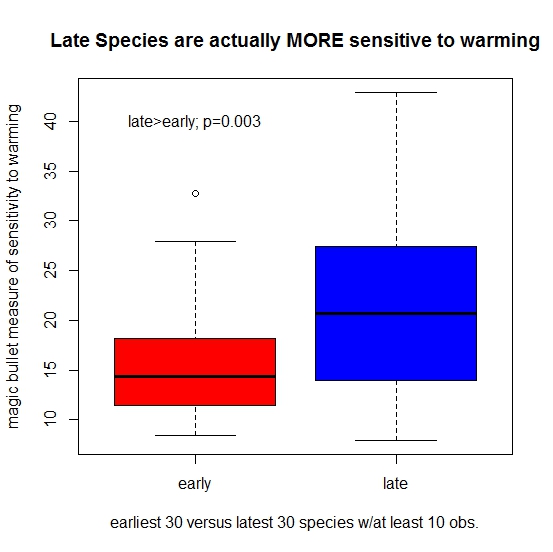
Flowering time and warming

It is a prevailing view that species that flower late have  flowering dates that are less sensitive to warming that species that flower early (See Wolkovich et al. 2012, Nature). If I do a quick analysis of the earliest and latest flowering species in the Flint Hills, this actually isn’t true. The y-axis is a new and more complex way of of quantifying sensitivity, and I wish to be discrete…but this is pretty cool. Image

← Back

Thank you for your response. ✨

Posted in Phenology, Weather and Climate | Tagged , , , , | Leave a comment

Warmest January-June on Record

The January-June period was the warmest on record for Manhattan, Kansas. The mean temperature over this period was 13.53 degrees celsius. The second warmest January-June period was 2006 with a mean temperature of 13.15 degrees celsius. If we fit a normal distribution to the data for all years except this year (1891-2011), the probability of having a January-June period chance of having a January-June as warm as 2012 is greater than 1 in 900. The histogram indicates the mean (green line), the fit distribution (black), and this year (red bar, data not used for distribution).

Is the mean temperature over this period warming at Manhattan, Kansas? The slope on the plot below is positive and significant (p=0.03, meaning that there is a 97% chance that it really is warming over the Jan.-June period). It is warming approximately 0.06 degrees per decade, but there is a lot of scatter, which isn’t surprising in a continental climate. There is little autocorrelation in the MHK data.

← Back

Thank you for your response. ✨

Posted in Weather and Climate | Tagged , , , , | Leave a comment